15 Brain Development Activities for a 2-Year-Old (That Actually Work)
A paediatric physiotherapist's field-tested list of 15 activities that stimulate both hemispheres of your 2-year-old's brain — using only what's in your house.
Two is when the brain wires itself fastest. Between 24 and 36 months, your child forms more than a million neural connections per second — and the activities you offer them literally shape which connections stay and which get pruned.
I've spent ten years working with adult neuro patients, relearning to move after a stroke. When my own daughter turned two, I started treating our play time the way I treated a rehab session: intentional, paired, and just hard enough to keep her engaged.
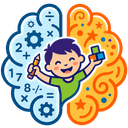
Here are 15 activities I do at home — seven for the left brain, seven for the right, and one that fires both at once.
The 7 left-brain activities (logic, language, sequence)
1. Number scoop
Put 20 chickpeas in a bowl. Give your toddler a spoon and an empty cup. Ask them to scoop exactly three. Then five. Then one. You are teaching counting and inhibitory control (stopping at the target number is harder than scooping).
2. Pattern snacks
Lay out cereal in a pattern: O — X — O — X. Ask "what comes next?" Use real food so the reward is immediate.
3. Sort-by-colour laundry
Give them a basket of socks in three colours. Three bowls. Say the colour aloud. Fifteen minutes of folded laundry and they've built a categorisation neural map.
4. Three-step instructions
"Pick up the banana, put it on the plate, bring it to me." Start with two steps. By 2.5 years, most children can handle three. This is a direct indicator of working-memory development.
5. Alphabet actions
For every letter, invent a body movement. A = arm up. B = bend. C = clap. Phonics + motor planning in one game.
6. Puzzle ladder
Start with 4-piece inset puzzles. When they finish one in under a minute three times in a row, move to 6-piece. Never push the next level; let them plateau.
7. Story retelling with a twist
Read the same book for five nights. On night six, "forget" a part. "What happened next?" You'll be shocked.
The 7 right-brain activities (creativity, emotion, spatial)
8. Finger painting with feet
Put a large paper on the floor, pour three dollops of paint, let them stomp. Whole-body proprioception + colour + mess tolerance.
9. Rhythm echo
Clap a pattern: clap-clap-PAUSE-clap. Ask them to copy. Then let them lead. This is cross-hemisphere timing work.
10. Emotion flashcards
Print faces: happy, sad, angry, scared, surprised. Point to your own face. "Am I happy or sad?" Then swap.
11. Dough sculpting
Play-Doh or atta mixed with salt. Ask them to make a snake. Then a circle. Then "what you had for breakfast." You're converting a memory into a 3D form.
12. Music body map
Put on fast music — shake arms. Slow music — sway hips. Silence — freeze. Regulation of the nervous system through rhythm.
13. Sensory bin
Rice + lentils + scoops + empty cups. Change the textures every week (water beads, dry pasta, kinetic sand). Sensory integration is a real, measurable developmental outcome.
14. Hide-the-toy storytelling
Hide a stuffed animal, then "interview" the toy when you find it. Where did it go? Who did it meet? You're scaffolding imaginative narrative.
The one bridge activity
15. Count-and-draw
Count 5 objects aloud together. Now draw 5 circles on paper and colour each a different shade. You just used left-brain counting, right-brain colour choice, and fine motor planning in one flow.
How to actually do this
Pick two activities a day — one left, one right. Ten minutes each. That's it. Consistency beats variety for a 2-year-old.
If your child resists, it's usually too hard or too easy. Drop down a level. Play should feel like a warm win, not a test.
This is the exact framework behind our WholeBrainKids program — 45 minutes, twice a week, with the same left-brain / right-brain / bridge structure. If you want the full 7-day printable version of these activities, download our free activity pack below.
Want the 7-day at-home activity pack?
Seven screen-free activities your 2–7 year old will actually enjoy — free, designed by Dr. Mansi Shah.
Get the free pack →