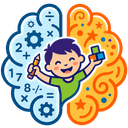
Left Brain vs Right Brain for Toddlers: What Parents Get Wrong
The left-brain/right-brain split is real — but not the way pop psychology tells you. Here's what matters for toddlers aged 2–5, and how to stimulate both sides without overthinking it.
"Is my child more left-brained or right-brained?" — I get this question almost every week. The honest answer: at 2 years old, neither. Hemispheric specialisation doesn't fully lock in until around age 5. What is happening is a massive, rapid build-out of connections both within and between the two sides.
So the goal for 2–5 year olds isn't to "develop the right brain." It's to develop the corpus callosum — the thick band of fibres that lets both sides talk to each other.
What the research actually says
- The corpus callosum undergoes its fastest myelination between ages 0 and 5.
- Children with richer cross-hemispheric communication show better impulse control, language flexibility, and emotional regulation later.
- The best activities aren't ones that "target" a side — they're ones that force both sides to work together.
What parents tend to get wrong
Mistake 1: Only doing "creative" stuff
Unstructured art + music + free play is wonderful — but without paired logic work, you're feeding only one side.
Mistake 2: Pushing academics too early
Worksheets, writing drills, screen phonics apps at age 2 — these stress the left hemisphere without the right's support. Children burn out.
Mistake 3: Believing the "left-brain = math, right-brain = art" meme
Reading requires both. Counting with objects requires both. Even finger painting is spatial logic + motor planning + emotional expression simultaneously.
What to do instead: the bridge principle
Every good early-learning activity fires both sides. Some examples:
- Counting with a song — language rhythm (R) + numeracy (L)
- Drawing a pattern — spatial expression (R) + sequence (L)
- Role-playing shopkeeper — social imagination (R) + counting money, making change (L)
- Building then labelling — construction (R) + vocabulary (L)
This is literally why the WholeBrainKids 45-minute session has three phases: 15 minutes left, 15 minutes right, 10 minutes bridge. The bridge is where the real wiring happens.
A simple test you can do tonight
Ask your 3-year-old: "Draw a tree. Now count how many leaves you drew." Watch the pause. That tiny switch between hemispheres is the muscle we want to strengthen.
If your child can do that smoothly, they're on track. If they struggle or refuse, they probably need more bridge play — not more worksheets, not more art. Bridge play.
Ready to go deeper?
Our Ahmedabad studio and online batches are built around this exact principle. Book a ₹99 trial and see a session for yourself.
Want the 7-day at-home activity pack?
Seven screen-free activities your 2–7 year old will actually enjoy — free, designed by Dr. Mansi Shah.
Get the free pack →